

A Brief History of the Martin Ranch and Its Forgotten Winter Legacy
by Ray Birks
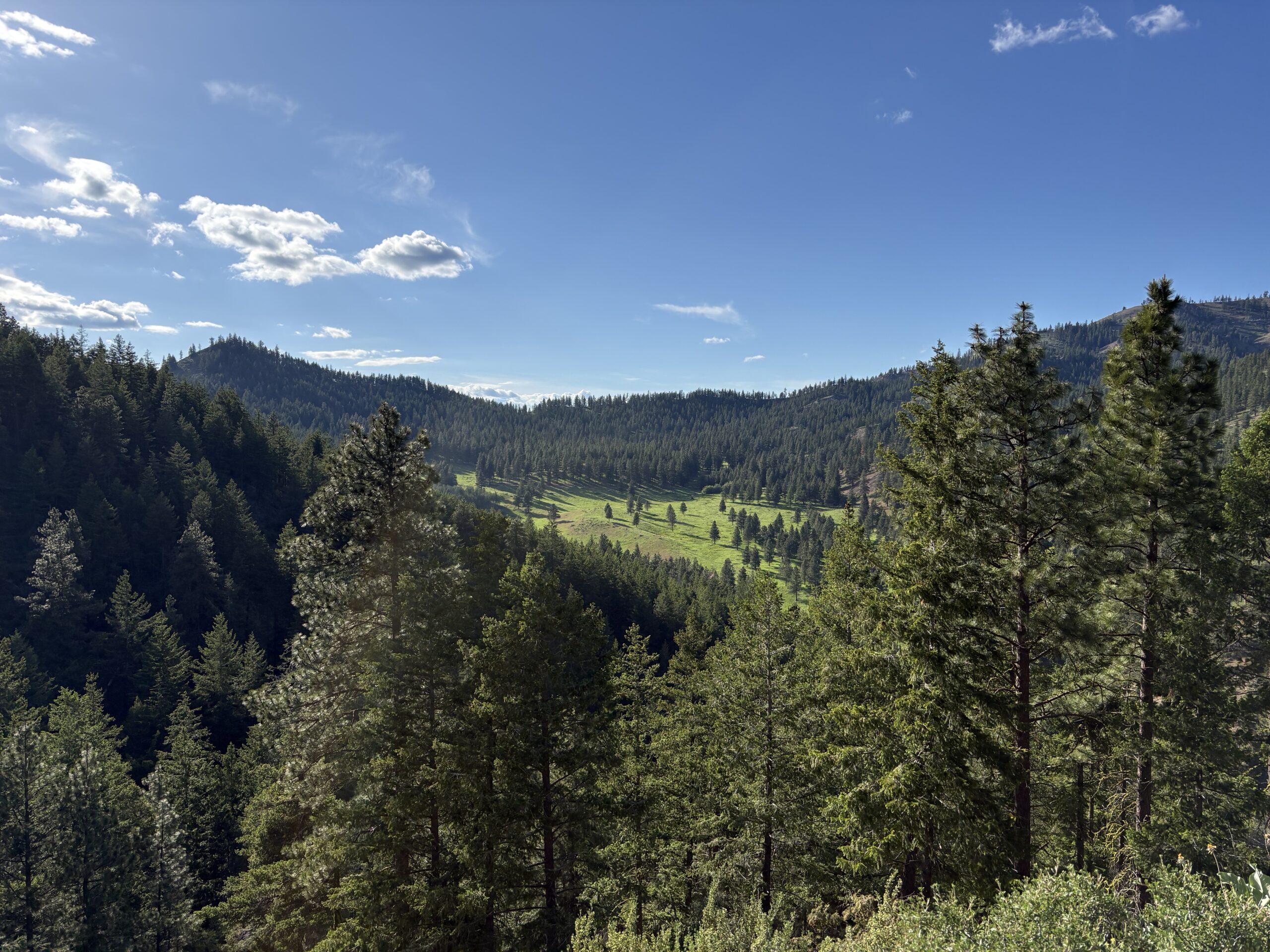
Hidden in the forests of Number Two Canyon lies the fading memory of a place once alive with skiers, racehorses, ranch life, and community activity. Today, little remains visible beyond scattered relics in the woods, old stumps, faint depressions in the ground, and stories passed down by a handful of people who remembered the area before time reclaimed it. Yet for several decades in the early twentieth century, the Martin Ranch and the Number Two Canyon ski hill were among the most unique recreation and ranching sites in the region.
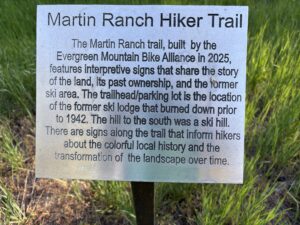
This article attempts to preserve what is still known about the history of the Number Two Canyon ski hill before the remaining traces disappear forever and borrows heavily, with permission, from Al Murphy’s research. Al built the 1.1 mile Martin Ranch hiking-only trail that weaves its way up the old ski hill. He also created the signs that detail the area’s history, which are placed along the trail where that history can still be seen. Al is also a wildland fire expert, retired forester for the U.S. Bureau of Land Management, and was also a recent recipient of the Bob Parlette award, which honors individuals who demonstrate exceptional dedication to public service and outdoor recreation in North Central Washington.
The Early Ski Hill
Sometime between approximately 1916 and 1942, a ski hill operated in Number Two Canyon. The exact dates are uncertain, and records are limited, but photographs preserved by local museums show skiers in the canyon as early as 1916. Whether those photographs depict the exact ski hill site in what is known as Section 15 is unclear, but they confirm that winter recreation was already taking place in the area during that period.
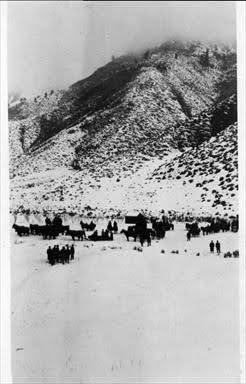
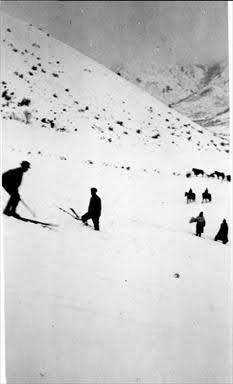
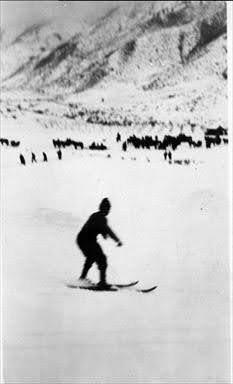
Photos used by permission from Wenatchee Valley Museum and Cultural Center.
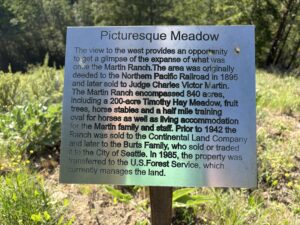
The ski hill was located on land that was originally granted to the Great Northern Railroad by the United States government in 1895 under the amended Pacific Railway Act of 1862. Around 1910, ownership of the canyon transferred to Judge Charles Victor Martin, whose long-term vision and development efforts shaped the area for decades and ultimately inspired its name.
Judge Martin transformed the property into a thriving ranch and recreational area. Near the junction of today’s 7100 Road and 500 Road, at the bend in the road where the seasonal gate is closed each winter, he built a large two-story log home measuring approximately 40 by 40 feet. The home reportedly featured a beautiful interior, fruit trees, and extensive vegetable gardens. Though nearly all traces of the structure have vanished, the site remains an important piece of the canyon’s history.
Not far uphill from the home, where a parking area was constructed in 2024, once stood a ski lodge. Some locals may still remember the isolated concrete slab that once sat at the base of the meadow. Historical evidence suggests the lodge may have gone through two separate construction periods before eventually burning down sometime before 1942. The foundations for the lodge remained visible for decades, even including evidence of indoor plumbing, before the area was redeveloped into the current parking lot. The lodge once stood on the site where the bathrooms are located today.
The Rope Tow
Perhaps the most fascinating surviving feature of the ski hill is the old rope tow.
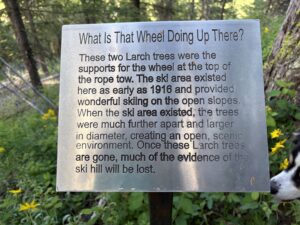
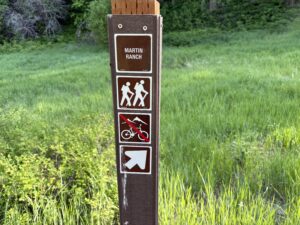
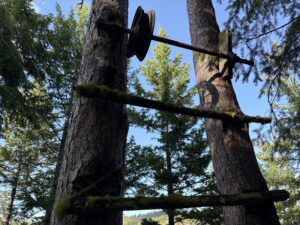
A hiking trail starts about seventy-five yards uphill from the former lodge site, now called the Martin Ranch trail, and remnants of the lift system can still be found in the meadow and hidden among the trees at the bottom and top of the trail. Suspended between two dead western larch trees is the large wheel that once served as the top pulley for the tow line. The trees still support the mechanism today, though both are long dead and could collapse at any time, potentially erasing one of the last recognizable artifacts of the ski hill.
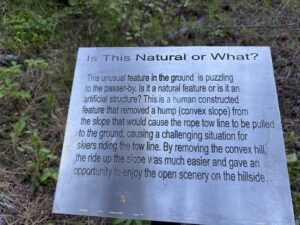
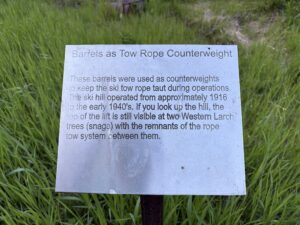
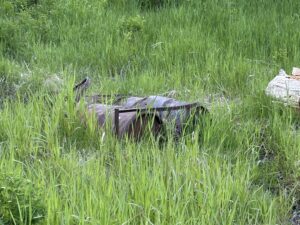
The lower section of the rope tow remains remarkably visible. Hikers will easily notice where builders excavated a trench-like path into the hillside to keep the moving rope from dragging against the ground and pulling riders downward. Near the base of the hill sit two welded barrels that acted as counterweights, maintaining tension on the rope and smoothing the tow’s motion as skiers mounted and dismounted.
There is also evidence suggesting the possibility of two additional rope tows. Another excavated line exists roughly one hundred feet west of the known tow route, while an old wheel hub was reportedly discovered about one hundred fifty feet east of it. No conclusive evidence has been found to confirm whether these were part of separate lift systems, but they hint that the ski hill may once have been larger and more developed than many realize.
A Landscape Shaped by Fire
Long before the ski hill existed, the canyon itself had already been shaped by wildfire.
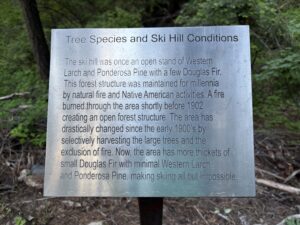
Historical accounts indicate that a major forest fire burned through the area sometime before 1902. Evidence of this earlier landscape can still be seen in the remaining old-growth stumps scattered across the north-facing slopes. The low number of ancient stumps, roughly five to ten per acre, suggests the hillside was once an open forest dominated by western larch and ponderosa pine.
This open terrain would have created nearly ideal skiing conditions.
Today, the same hillsides are densely packed with Douglas fir, in some places exceeding one thousand trees per acre where thinning has not occurred. Even in thinned areas, tree density remains far greater than during the ski hill’s active years. Researchers estimate many of the original larch and pine trees were between 500 and 600 years old before being harvested.
The stumps themselves preserve a record of changing technology. Many show axe and crosscut saw marks typical of early logging methods. Others display wider chainsaw kerfs associated with post–World War II harvesting equipment, suggesting portions of the area were logged again in the late 1940s or early 1950s.
Over time, the exclusion of natural fire and the removal of seed trees dramatically altered the forest composition. What was once an open larch-and-pine landscape is now overwhelmingly dominated by Douglas fir.
The Martin Ranch and the Racehorses
The ski hill was only one chapter in the broader story of the Martin Ranch.
Along the southern edge of a sprawling two-hundred-acre meadow, Judge Martin raised what were described as some of the finest blooded horses in Washington State. The meadow produced timothy hay for the ranch’s purebred racehorses, and nearby stood a carefully constructed half-mile oval racetrack used for training.
Though nearly invisible from the ground today, the track can still be identified through LIDAR imagery. It lies west of the meadow near the picnic shelter installed in 2024. A closer look at the map on the parking lot kiosk reveals the outline of the old racetrack.
Judge Martin’s devotion to horse racing was well known. Historical accounts describe a fine barn and at least seven purebred racehorses with pedigrees and racing records recognized throughout the United States. The ranch represented not only agricultural success but also a significant equestrian operation during its time.
Changing Ownership
Following Judge Martin’s ownership, the property passed through several hands.
Around 1942, the Martin Ranch was sold or traded to the Continental Land Company, apparently a speculative land-development organization interested in Number Two Canyon. The company later transferred the property to Tim Williams, who owned it only briefly before selling the approximately 840-acre ranch to the Burts family.
The Burts family already owned nearby land in the Horse Lake area north of the canyon. After several years, they sold the property to the City of Seattle, likely sometime during the 1960s, as the city assembled land holdings for watershed-related exchanges.
In 1985, the City of Seattle traded the property to the United States Forest Service, and today the land is managed as part of the Okanogan-Wenatchee National Forest.
Remembering What Remains
Al writes that researching the history of Number Two Canyon proved difficult. Nearly everyone with firsthand knowledge of the ski hill had passed away, and surviving written records were scarce. Even longtime skier Otto Ross, at one hundred years old, reportedly remarked that there was likely no one left who truly remembered the ski hill.
And yet traces remain.
The wheel suspended between dead larch trees. The buried rope tow trench. The welded barrels hidden near the base of the slope. The ghostly outline of a horse track revealed through modern imaging technology. Together, these remnants tell the story of a forgotten era when Number Two Canyon was far more open, active, and alive with people than it appears today.
This history is incomplete, and perhaps it always will be. But preserving even fragments of the story ensures that the legacy of the Martin Ranch and the Number Two Canyon ski hill will not disappear entirely into the forest.
